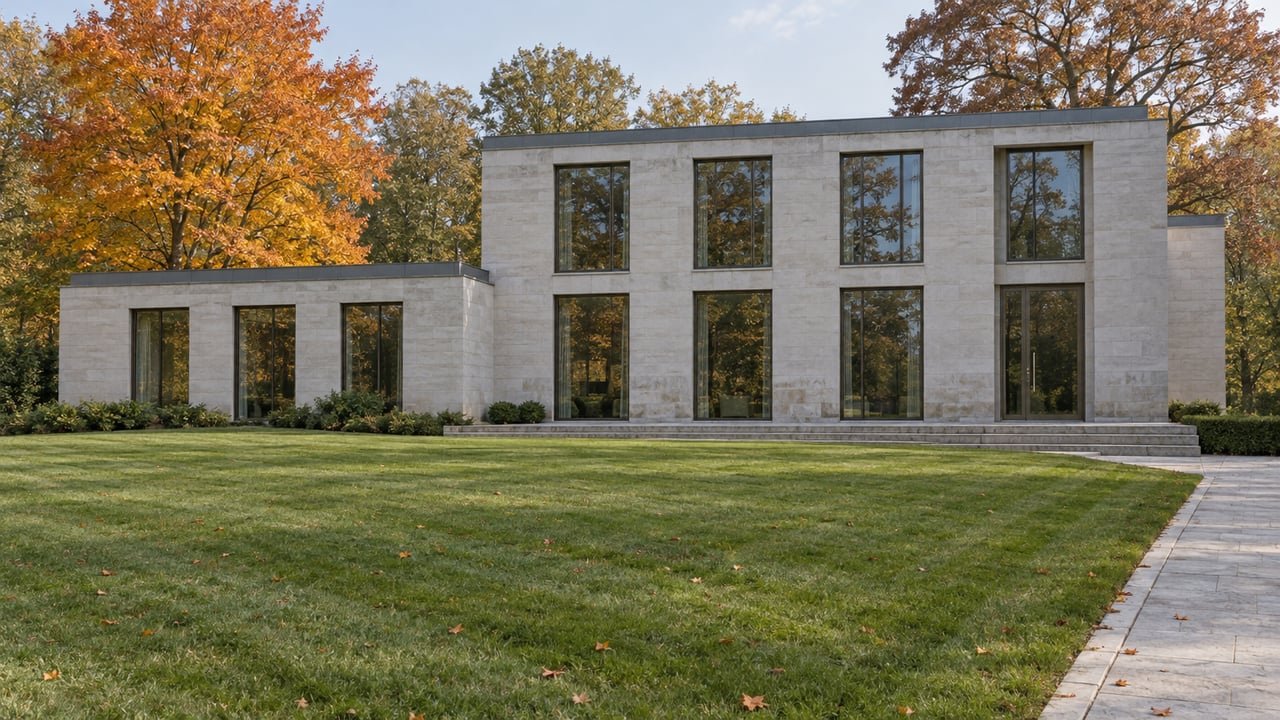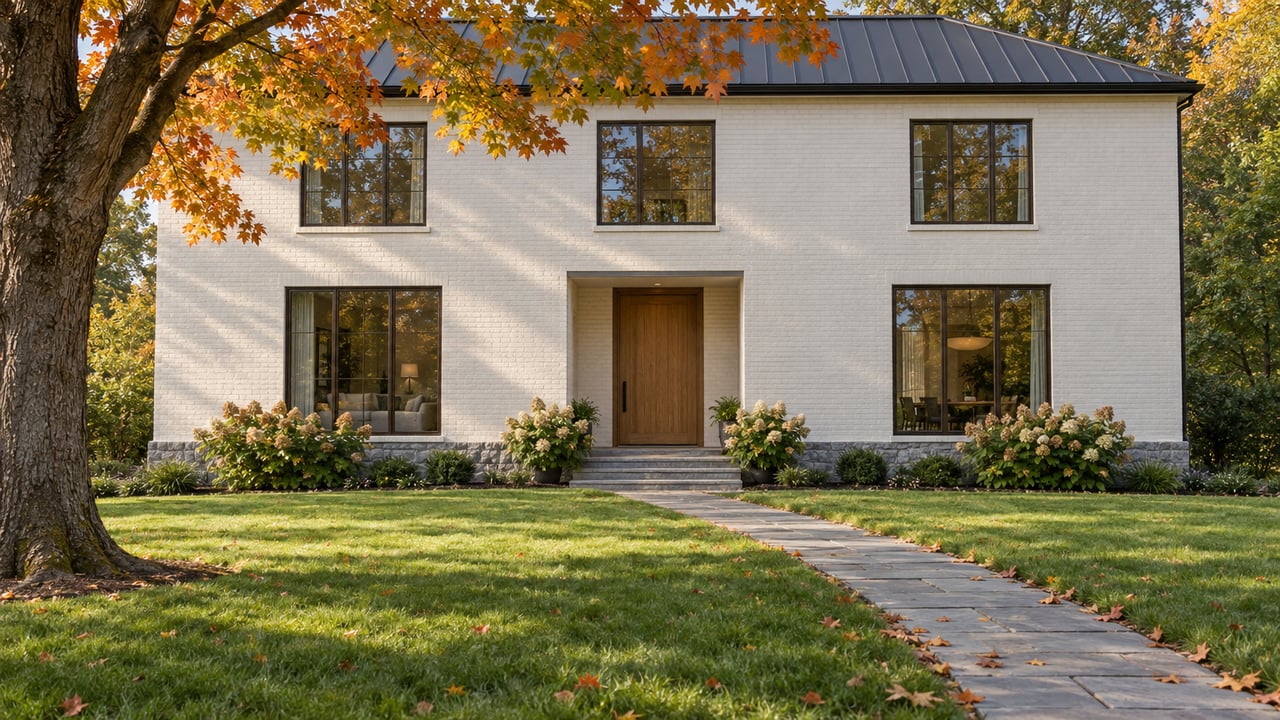
Say you find it: a half-acre lot in one of Wellesley's older pockets, a tired 1950s cape sitting on land that's clearly worth more than the house. The listing price looks like a straightforward equation. Land value plus demolition plus construction equals your new home. Most buyers run that math before they ever call their lender.
Then the arborist walks the lot, and the number changes. Not because the house is more expensive to tear down than expected, but because of what's growing in the yard.
What The Listing Price Actually Buys
In Wellesley's established neighborhoods, teardown-candidate lots typically sell for something in the range of $900,000 to $1.5 million for the land alone, with the structure on top contributing little to nothing to that value. Add demolition, generally $30,000 to $60,000, and new construction at $400 to $600 or more per square foot for quality building in the greater Boston market, and an all-in project often lands somewhere between $2.5 million and $4 million for a finished home on a premier street.
That math covers the visible costs: land, demo, framing, finishes. It does not cover the two town processes that stand between your closing and your building permit, and one of them is priced by the tree.
The Zoning Test That Decides How Big You Can Build
Every new house or major addition in Wellesley gets measured against a number called TLAG, short for Total Living Area plus Garage Space. It's the town's way of calculating square footage so builders can't hide it in unfinished attics or oversized garages. Wellesley's TLAG application says that if your proposed TLAG exceeds the threshold set for your zoning district, the project has to clear Large House Review by the Planning Board before a building permit gets issued.
The thresholds scale with lot size. In a 10,000-square-foot district, the trigger is 3,600 square feet of TLAG. It's 4,300 in a 15,000-square-foot district, 5,900 in a 20,000-square-foot district, and 7,200 in the town's largest 30,000 and 40,000-square-foot districts. The review fee runs $2,000 for a new home under 5,900 square feet of TLAG and $3,000 at or above it, with additions priced on a sliding percentage of that same fee.
This isn't a hypothetical hurdle. As of August 2026, applicants in Wellesley Hill were filing a TLAG affidavit with the town's Building Department. The paperwork is public. The process is active right now, not a rule buried in a code book from a decade ago.
The Tree Bill That Arrives Before The Foundation Does
Large House Review is the cost most buyers eventually hear about. The Tree Preservation Bylaw is the one that surprises people mid-permit.
Section XVIE of Wellesley's zoning code protects any tree with a trunk diameter of 10 inches or more standing in a property's tree yard, and it activates the moment you apply for a permit to demolish a structure, build a major addition, or cut a public shade tree. Remove a protected tree without replanting on site at the required ratio, and you owe the town's Tree Bank a per-inch fee instead. The math is tiered, and it adds up faster than most renovation budgets account for. McDonald Tree's Wellesley tree-bylaw guide puts a 24-inch maple removed without replanting at about $4,000. A 30-inch oak runs roughly $5,500. A 50-inch heritage oak comes in around $10,500. A single 76-inch copper beech, and mature specimens like that do exist on some Wellesley lots, can cost more than $17,000 on its own. Multiple protected trees on one property stack. A demolition lot with three mature maples and one large oak can clear $20,000 in Tree Bank contributions before a single stud goes up.
Even the trees you plan to keep come with a cost, just a different kind. The bylaw protects the Critical Root Zone around every retained tree, calculated as the trunk diameter in inches multiplied by 18. A 20-inch oak needs a 30-foot buffer of undisturbed soil. No heavy equipment, no grading, no trenching inside that circle. Most lost trees on Wellesley renovation sites aren't chainsaw losses. They're a backhoe parked in the wrong spot for three weeks during demo, and the tree dies quietly the following summer, by which point construction is finished and there's no reversing it.
Demolition Delay Rules and Market Prices in Wellesley and Needham
None of this happened by accident. In 2017, Wellesley's Town Meeting adopted a 12-month demolition delay for any home the Historical Commission judges worth preserving, a deliberate response after the commission's own chairman argued that the absence of such a delay had "lured many a developer to town to snap up teardown targets." Needham, by comparison, runs a demolition delay, and its own Historical Commission has publicly wondered whether even that is long enough to matter, given how closely it tracks ordinary permit timelines.
The length of a demolition delay may matter differently to homeowners and builders. Builders financing a teardown-rebuild may incur carrying costs while a project waits on a commission decision. Separately, the price-per-square-foot premium Wellesley once held over Needham has changed: a year ago that gap was roughly $150 per square foot. By this spring it had narrowed to somewhere around $61.
Wellesley land hasn't gotten less desirable. The permitting math now runs differently in two towns that used to feel interchangeable to a builder, and the price-per-square-foot comparison has shifted as well.
Where The Math Tips By Neighborhood
The renovate-or-rebuild decision doesn't play out the same way on every Wellesley street. In Cliff Estates and Overbrook, a teardown-and-rebuild cycle has already been running for years, visible in the newer construction sitting next to older homes on the same block. Overbrook in particular has seen fresh demand since Hardy Elementary opened its 80,000-square-foot, net-zero-ready building in August 2024, pulling buyer interest into the surrounding streets. In Poets Corner and Lower Falls, solid mid-century homes still hold enough value that renovation competes on its own terms, since the land underneath them doesn't carry the same outsized premium over the structure. Wellesley Farms sits somewhere in between, close to its own commuter rail stop, with older and newer homes trading at similar rates depending on the lot.
Before writing an offer on a teardown-candidate lot anywhere in town, walk it with an arborist and check whether the home shows up on the Historical Commission's radar. Those two conversations, not the asking price, are what actually move a project budget.
A Few Questions Before You Write An Offer
Does every teardown in Wellesley trigger Large House Review? No. Large House Review does not apply to every project.
Can I remove trees before I even close on the lot to avoid the fee? The bylaw is triggered by a permit application for demolition or construction, not by a change in ownership. A tree removed with no pending building permit generally falls outside Section XVIE, though the town's Natural Resources Commission asks that anyone doing tree work call first, since the line between a private tree and a protected one is not always obvious from the yard.
What happens if the Historical Commission flags my target house? The 12-month delay clock starts, a timeline buyers and builders can weigh when evaluating older homes that may be preservation candidates.
Does keeping the new house smaller sidestep both bylaws? Not automatically. TLAG counts basement, attic, and garage area whether finished or not, so a smaller-looking footprint doesn't always produce a smaller number on the town's calculation.
A teardown lot in Wellesley can still be the fastest way to a custom home on a street you couldn't otherwise access. It just isn't priced the way the listing sheet suggests. The Shulkin Wilk Group works with buyers and sellers on exactly these transactions across MetroWest, walking the permitting math alongside the purchase price before an offer goes in. If you're weighing a teardown lot, a large addition, or a sale of a property that might interest a builder, reach out and List With Us.
This article is general information, not legal, tax or financial advice. Consult a qualified professional about your situation.